The Science
Pathological Effects of Inescapable Low-Frequency Hum from Hyperscale Data Centers
Audience: Residents, Community Organizers, and Land-Use Advocates
1. Introduction: The Mechanical Blueprint of Modern AI Data Centers
Unlike legacy data centers built in the 2010s—which acted essentially as large office buildings housing quiet telecommunication switches—modern 2026 hyperscale Artificial Intelligence (AI) facilities operate as heavy industrial processing plants.
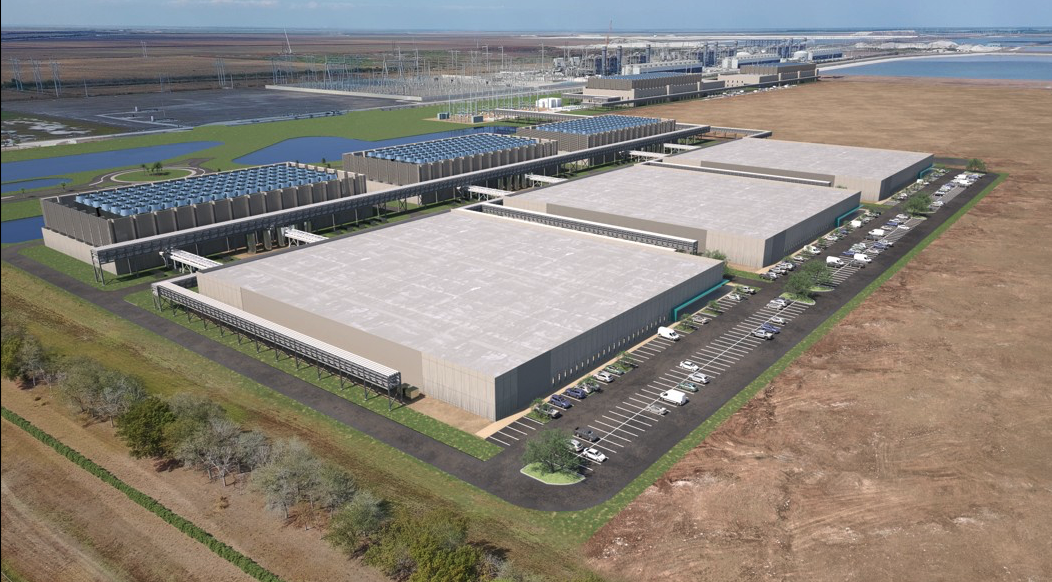
The graphics-heavy processing units (GPUs) required to train modern AI algorithms generate an unprecedented thermal load. This requires continuous heat rejection managed by massive, open-air cooling infrastructure consisting of hundreds of high-velocity industrial chillers, cooling towers, and computer room air handler (CRAH) fans running 24 hours a day, 365 days a year.
The mechanical friction, blade-pass frequencies, and motor rotations of these systems generate a permanent acoustic footprint dominated by low-frequency noise (LFN), typically defined as sound energy concentrated between 10 Hz and 200 Hz.
2. The Acoustic Inevitability of Low-Frequency Waves
The physical properties of low-frequency sound waves make them inherently destructive to residential zoning boundaries due to three structural factors:
Atmospheric Resilience: High-frequency sounds (like a whistle or siren) have short wavelengths that attenuate (die out) rapidly over short distances due to atmospheric absorption. Low-frequency sounds have macro-wavelengths stretching up to 50 feet. These long waves travel over miles with virtually zero atmospheric dampening.
The Diffraction Effect: Standard sound barriers, earth berms, and concrete perimeter walls use "line-of-sight" blocking. Because low-frequency acoustic wavelengths are larger than the thickness and height of standard walls, the waves effortlessly bend over the top of the barrier (diffraction) and continue into the neighborhood unimpeded.
Building Envelope Penetration: Standard building materials (drywall, stucco, glass, and concrete block) have a low "Sound Transmission Class" (STC) rating for low frequencies. These waves easily penetrate residential building envelopes. Once inside a home, they can cause structural resonance—vibrating walls and air columns, effectively turning a bedroom into an acoustic amplifier for the hum.
3. The Regulatory Blind Spot: dBA vs. dBC
The core regulatory loophole used by data center developers to gain administrative approval near residential zones lies in the mathematical "weighting" scale used by municipalities to enforce noise ordinances.
The dBA Scale (A-Weighted Decibels)
Developed in the early 20th century, the A-weighting scale was designed to replicate the human ear's response to low-intensity, mid-frequency sounds (like human conversation). To do this, the dBA scale mathematically filters out and heavily discounts lower frequencies. For example, at 31.5 Hz, the dBA scale subtracts 39.4 dB from the actual sound pressure level.
The dBC Scale (C-Weighted Decibels)
The C-weighting scale provides a flat, unattenuated measurement of the low-frequency register. It accurately captures the heavy, mechanical energy that rattles windows and penetrates walls.
The Loophole Demonstrated
Because Palm Beach County's 2016 Unified Land Development Code (ULDC) evaluates sound thresholds exclusively in dBA, a developer can submit an acoustic report showing perfect compliance. On paper, the facility might read as a quiet 45 dBA at the property line.
However, because the dBA filter hides the low frequencies, that exact same spot could be registering a highly invasive, window-rattling 70 dBC. Administrative county staff, legally bound to look only at the dBA checkbox, have no regulatory mechanism to catch or deny this footprint.
4. Pathological Evidence: How Industrial Hum (LFN) Affects Human Biology
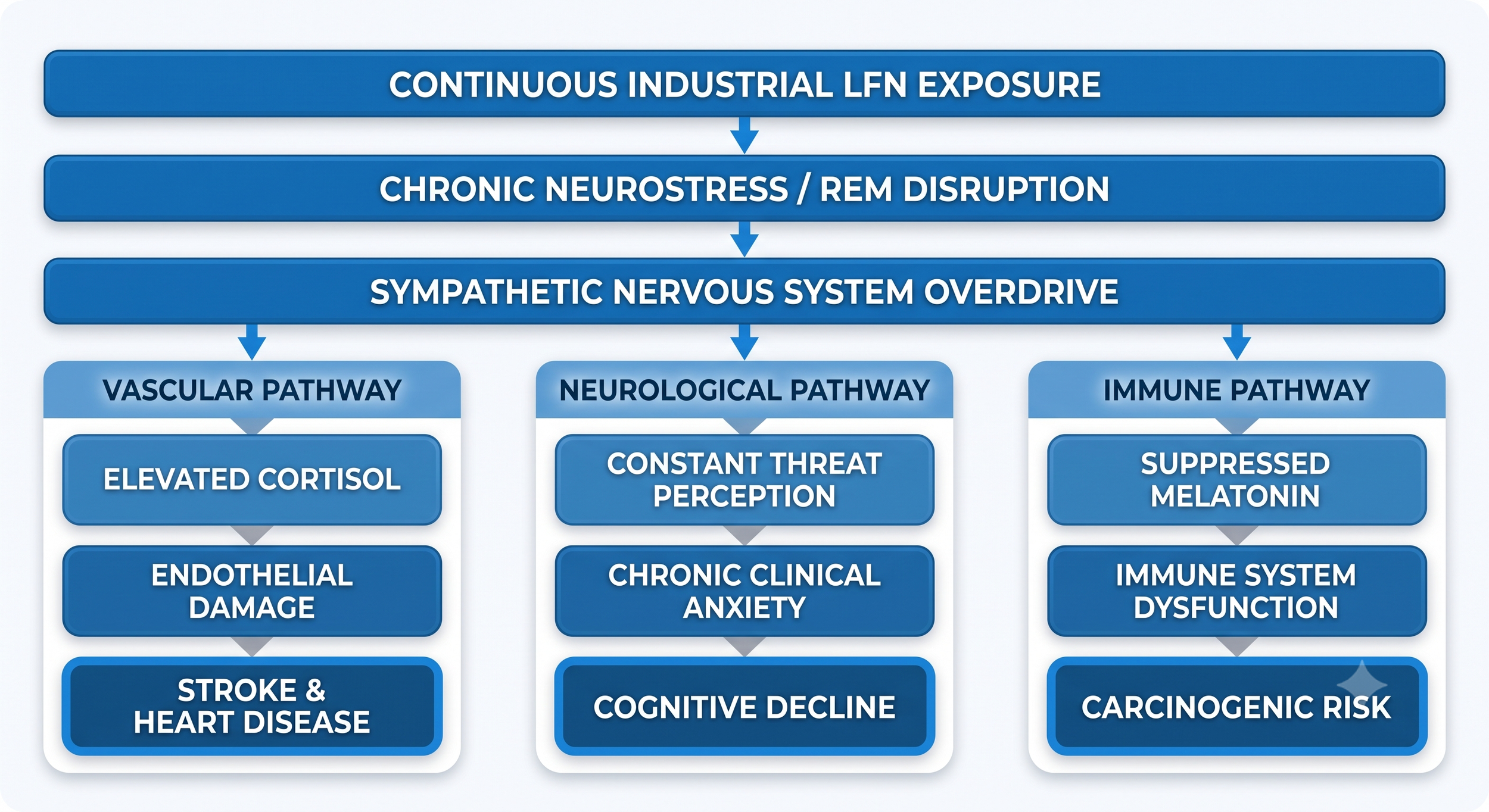
When the human body is subjected to a continuous, inescapable low-frequency vibration, it does not perceive it simply as an annoying sound. Because the acoustic waves are felt physically by internal organs, tissues, and the vestibular system, the brain registers the low-frequency hum as an environmental threat indicator.
Decades of peer-reviewed neurological, cardiovascular, and epidemiological research have documented the systemic health degradation caused by chronic exposure to low-frequency noise (LFN):
5. Developer Claims vs. Documented Research
What the Developer Claims: "We are installing standard sound barriers and landscaping to contain the noise."
What the Documented Research Proves: Useless. Low-frequency waves have wavelengths up to 50 feet; they bend right over walls and pass through solid barriers unimpeded.
What the Developer Claims: "Our sound studies prove we comply perfectly with local county noise ordinances."
What the Documented Research Proves: Deceptive Metric. Their studies use dBA decibels, which mathematically erase low-frequency hums from the data.
What the Developer Claims: "Data center sound is just ambient white noise, like a gentle household refrigerator."
What the Documented Research Proves: Toxic Neurostressor. It is an inescapable 24/7/365 industrial vibration that triggers chronic cortisol spikes, sleep architecture breakdown, and cardiovascular stress.
6. Primary Scientific & Legal References for Review
To independent researchers and residents verifying these claims, please cross-reference the following core authorities:
World Health Organization (WHO): Environmental Noise Guidelines for the European Region (and Americas).Documenting the definitive links between environmental noise, sleep architecture destruction, and ischemic heart disease.
American National Standards Institute (ANSI): ANSI/ASA S12.9 (Quantifying Noise With Respect to Land Use).Specifying the unique structural rattle and high community annoyance rates caused by low-frequency sounds down to the 16 Hz band.
European Society of Cardiology (ESC): Environmental Noise Pollution and Cardiovascular Risk (Clinical Research Monograph). Outlining how noise-induced cortisol spikes cause systemic endothelial dysfunction and arterial wear.
Virginia Zoning Modernization (2025-2026 Ordinances): Fairfax County Board Amendments & Prince William County Zoning Text Amendments. The real-world legislative proof that modern local governments are actively stripping administrative "by-right" approvals for data centers due to these identical acoustic and infrastructure realities.
Technical & Peer-Reviewed References: Data Center Noise and Public Health
1. The Proximity and Propagation Reality of AI Infrastructure
Modern AI data centers do not utilize standard light-commercial cooling. Hyperscale facilities operate hundreds of heavy industrial cooling towers, computer room air handlers (CRAH), and chiller compressors that generate strong tonal energy concentrated in the 8 Hz to 63 Hz low-frequency register.
The Science: High-frequency sounds rapidly decay in the atmosphere, but low-frequency noise (LFN) has macro-wavelengths spanning up to 50 feet. This structural property allows LFN to travel over miles with virtually zero atmospheric absorption. LSARS (Life Science Analysis & Reporting Solution)
Acoustic Penetration: Standard concrete block walls, earth berms, and impact glass provide effective defense against high-frequency sounds, but fail to block low frequencies. Because the acoustic wave is wider than standard barriers, it undergoes diffraction—effortlessly bending over perimeter walls and directly penetrating residential building envelopes, creating structural resonance inside homes up to 3,000 feet away. LSARS
Peer-Reviewed Precedent:“Infrasonic and Low-Frequency Noise Exposure from Large Data Centers: A Proposed Analytical Framework” (ResearchGate, 2026): Confirms that cooling infrastructure and chiller compressors create massive quantities of continuous infrasonic and low-frequency noise (ILFN) predominantly below 200 Hz that cannot be blocked by traditional sound barriers. ResearchGate
2. The Mathematical Deception of the dBA Scale
The core loophole used by data center developers to slip through administrative reviews is the misuse of the A-weighted decibel (dBA) scale.
The Science: The dBA scale was engineered to match human hearing for low-intensity, mid-frequency sounds (like conversation), meaning it intentionally filters out and discounts lower frequencies from its mathematical totals. For instance, at a bass frequency of 31.5 Hz, the dBA filter automatically subtracts 39.4 dB from the raw sound pressure level.
The Discrepancy: Conversely, the dBC (C-weighted) scale measures the flat, raw impact of low-frequency industrial noise. Because municipalities only audit the dBA checkbox, a data center can measure as a "quiet" 45 dBA at a neighborhood line, while simultaneously subjecting residents to an invasive, vibrating 70 dBCfootprint.
Scientific and Industry Standards:
Larson Davis Technical Specifications (Acoustic Monitoring Standards): Documents that common community noise regulations (written for standard 50 dB–60 dB limits) fail entirely because they were not written with constant, 24/7/365 low-frequency noise in mind, allowing invasive fan hums to pass compliance checks unchecked. Larson Davis
American National Standards Institute (ANSI) Standard S12.9: Formally establishes that low-frequency environmental noise down to the 16 Hz band causes the highest rates of community annoyance and internal residential structural rattles.
3. Pathological Effects on the Human Nervous System
When the human body is subjected to a constant, inescapable low-frequency vibration, the brain interprets it via the vestibular and endocrine systems not as a "sound," but as an environmental threat indicator.
The Fight-or-Flight Response: Continuous exposure to LFN forces the sympathetic nervous system into a permanent, low-grade overdrive, continuously pumping stress hormones into the bloodstream.
Sleep Architecture Destruction: LFN does not need to fully wake an individual to destroy their health; it disrupts critical REM and deep sleep phases, preventing biological cellular repair and suppressing natural melatonin production. Environmental Health Sciences
Chronic Disease Links: Long-term exposure to this noise-induced physiological stress leads directly to heightened risks of arterial stiffness, strokes, clinical anxiety, and cardiovascular disease. UCLA Health
Peer-Reviewed Precedent:
Cardiovascular Links: The European Society of Cardiology (ESC) / Center for Occupational and Environmental Health monographs: Prove that ongoing, chronic exposure to low-frequency noise pollution and continuous background fan noise directly triggers a systemic inflammatory state and elevated blood pressure, scaling up the risk of myocardial infarction (heart attacks) and strokes. UCLA Health
The Cortisol Spike: “Low frequency noise enhances cortisol among noise sensitive subjects” (ResearchGate / PubMed): Discovered that exposure to continuous ventilation and low-frequency noise directly stops the human body's natural nighttime circadian decline of cortisol, keeping stress hormones abnormally elevated.
Sleep Fragmentation: “Effects of nighttime low frequency noise on the cortisol response to awakening and subjective sleep quality” (Life Sciences / Ovid):Documented that nighttime exposure to LFN directly alters normal waking biological patterns and severely degrades subjective sleep quality, mood, and immune performance.